Friday, January 7, 2011

Harga emas cecah RM4,650 seaun

Oleh SARAH NADLIN ROHIM

KUALA LUMPUR 6 Jan. - Harga emas dunia bakal mencecah paras AS$1,500 (RM4,650) satu auns pada tahun ini, kata Pengerusi Eksekutif dan Pengarah Urusan Poh Kong Holdings Bhd. (Poh Kong), Datuk Eddie Choon.

Katanya, peningkatan itu dijangka berlaku memandangkan trend semasa dan permintaan berterusan di pasaran.

''Pada tahun lalu, harga emas bagi satu auns adalah sekitar AS$1,400 (RM4,340) dan ia terus meningkat.

''Walaupun pada awal tahun ini, harganya mengalami sedikit penurunan, tetapi kami yakin ia bakal mencecah AS$1,500 satu auns,'' katanya.

Beliau berkata demikian selepas di minta mengulas mengenai harga pasaran semasa emas pada sidang media selepas mesyuarat agung tahunan Poh Kong di sini hari ini.

Hadir sama, Ketua Perhubungan Korporat, Pentadbiran & Sumber Manusia, Margaret Hon dan Akauntan, Hoh Sze Haw.

Tahun lalu, harga komoditi mengalami lonjakan positif apabila ditutup pada paras yang tinggi terutama bagi emas hingga ke minyak mentah.

Harga emas ditutup pada paras AS$1,421.40 (RM4406.34) satu auns pada hari terakhir 2010, naik kira-kira 31 peratus berbanding tahun sebelumnya.

Para penganalisis menjangkakan trend peningkatan harga akan berterusan pada tahun ini kerana emas merupakan komoditi paling cemerlang dari aspek peningkatan harga pada tahun lalu.

Secara tradisinya ia dilihat sebagai pelaburan perlindungan nilai dan sering digunakan sebagai mekanisme lindung nilai terhadap deflasi.

Sementara itu, ketika ditanya mengenai perkembangan perniagaan, Choon berkata, pada tahun ini Poh Kong akan menambah tiga lagi cawangan dengan pelaburan sebanyak RM9 juta.

''Tiga cawangan tersebut terletak di Semenanjung Malaysia dengan yang pertama adalah di Nilai, Negeri Sembilan dijangka dibuka pada suku pertama tahun ini.

''Dua lagi cawangan masih belum dikenal pasti. Pelaburan bagi setiap cawangan adalah sebanyak RM3 juta,'' jelasnya.

Penambahan tiga cawangan itu akan menyaksikan Poh Kong memiliki 100 buah cawangan di seluruh negara.

Tambah beliau, setakat ini fokus perkembangan perniagaan adalah tertumpu di Semenanjung Malaysia.

''Dalam masa terdekat ini, kami masih belum merancang untuk menambah cawangan di Malaysia Timur dan di luar negara.

''Tetapi kami sentiasa meninjau sebarang peluang. Sekiranya ia bertepatan dengan kehendak perniagaan Poh Kong, kami akan pertimbangkan pada masa hadapan,'' katanya.

Poh kong menguasai 15 peratus pasaran barangan kemas emas dan tahun ini merupakan ulang tahun syarikat itu yang ke 35 tahun.

Pelbagai promosi dijalankan bagi menyambut ulang tahun itu sehingga 31 Ogos ini.

Tuesday, January 4, 2011

Pendapatan lumayan


Antara paparan kejayaan sebahagian pengedar PG. Anda ingin mencuba, hubungi saya, 019-2827473. Malu bertanya peluang terlepas.

Gold Dinar as Halal Money - Part 1

Gold Dinar as Halal Money - Vivy Yusof - Halal Journal Print E-mail

Many are aware of the concept of Halal money, but to them, Halal money is money obtained in an honest way, which means not by gambling. There is a bigger issue to be addressed regarding Halal money, and the secret lies within the currency note itself.

If I told you that your RM50 note is worth nothing, would you believe me? This all comes down to history. Let's recap: in the 1800s, colonies robbed us by monopolising our land, taking our resources. In return, they issued a paper IOU, which is a promise to pay, signed by their companies involved. While waiting and wishing for our tangible returns, the IOUs were circulated and used by us, as a medium to trade. The paper IOUs gradually decreased in size and were beautified by pictures of the rulers. Soon, they were accepted as a medium of exchange, and known to all of us as Money, something we all chase for to survive.

This shows that while God has given Muslim countries so much richness such as oil, precious metals and fertile land, we generously hand them over to others and succumb to their manipulations. Paper money as a dishonest tool is a highly sensitive topic to touch upon, and determining the Halal aspect of it would be best left to the Ulamas to decide. However, we can all use our common sense with this simple example. The third pillar of Islam urges Muslims to pay Zakat, which is the act of giving a proportion of our income to the poor. Zakat is only to be paid with tangible goods, such as gold, goats, and camels. Many Muslims just shake off their Zakat responsibility by paying using paper money. Considering the origins and history of paper money, being just a promise to pay, is our Zakat accepted in Islam? Ultimately, paper money symbolises a debt, and in Islamic law, a debt cannot be used as a medium of exchange.

Zakat has to be paid with honest and Halal money, and what springs to mind is the obvious; Dinar. This 100 per cent gold coin fits the requirement of Halal as it has value and is tangible merchandise. One of the persons most passionate about Gold Dinar is Umar Ibrahim Vadillo, who wrote The Return of the Islamic Gold Dinar. He is one of those who believe strongly that any true Muslim carries the responsibility to reject paper money. To him, paper money is a form of "fraud" despised by Allah and therefore, the absolute worst thing a Muslim can do is to use it. He believes the only means of exchange allowed by Syariah law are gold Dinar and silver Dirham.

He quotes the words of Imam-ad-Dean Ahmad which says, "Muslims cannot escape the fact that gold is our money. Instead of fighting the will of Allah, I propose that we embrace it. If the 1 billion Muslims of the world would use gold as their unit of account, the volatility would stabilise."

There is another person closer to our hearts fighting for the good of gold Dinar; Malaysia's former Prime Minister, Tun Dr. Mahathir Mohamed. In 2003, he, along with his economic adviser, Tan Sri Nor Mohamed Yakcop, proposed the introduction of Islamic gold Dinar as currency to be used for international trade among the Muslim countries. Reason for this is to suppress the overly-traded US dollars and to ensure that the US dollar's instability does not affect our international trade. Islamic gold Dinar is more stable in the sense that it is tied to the price of gold. The idea of using gold instead of the paper money is understandably a bizarre one to many. We might not be able to imagine people going about their everyday lives carrying bags of gold instead of thin currency notes. However, shouldn't we be patient and open-minded so as to see the other side of the story, perhaps the better side?

So, why gold? As elaborated by Umar Ibrahim in his book, gold is an asset that is no one else's liability. According to him, paper assets (bonds, shares, and so on) are promises to repay money borrowed, and its value is dependent upon the investor's belief that the promise will be fulfilled. Gold by itself is a precious metal. No one can deny that gold is valuable and always treasured. Gold cannot be created or destroyed, whereas paper money can be easily torn, burned or created numerously. Only a fool would turn down the idea of receiving gold. Also, gold would not contribute to inflation problems. For example, during Prophet Muhammad's (peace be upon him) time, a chicken costs 1 Dirham (silver). Today, a chicken still costs approximately 1 Dirham. Therefore, within over a thousand of years, the effect silver had on inflation is virtually zero. On the other hand, the existence of paper money has caused prices to increase ten-folds! The value of gold is independent of the financial system, whereas the value of currencies depends on the strength of their countries. If we wanted stability, the obvious answer would be to choose gold.

Gold Dinar is already used in some Islamic countries, but still very small-scaled. The World Islamic Trading Organisation, following the standards of Umar ibn Al-Khattab, established that one Dinar is equivalent to 4.25g of 22K gold and 23mm in its diameter size. In recent years, China is also showing affinity to gold, as their people are encouraged to buy and trade gold. The Chinese government is committed to increase their gold reserves to reduce reliance on the US dollar. India is another example of a country that has a high demand of gold. The Indians find gold as a commodity of immense value in their religious beliefs, and feel that gold is the only form of protection for Indian rupees against the US dollar. Currently there are 1.3 billion Chinese, 1.1 billion Indians and 1.8 billion Muslims, together representing more than 60 per cent of the world population. If we unite to use gold as currency, there would be a definite shift of power to the East.

Imam Malik defined money as "any merchandise commonly accepted as a medium of exchange." In the past, when people were free to choose, they chose gold and silver as their money, as their medium of exchange. Now, we are legally forced to succumb and agree to the use of paper currency. Perhaps, if we are given the freedom to choose again, it would be a completely different scenario, and gold and silver would enter the picture again. Increasing awareness of the importance of gold Dinar is a success for the Muslims.

More people are accepting that it is more Islamic to use gold as currency. More people are believing that monetary crisis we face these days are caused by paper money, which can be printed over and over again. More people are realising that this repetitive problem will never stop unless something is changed. More people are opening their eyes, but sadly, only a handful of them are opening their mouths to make a difference. When asked about if the introduction of an Islamic Gold Dinar could be realised, Tun Dr Mahathir replied, "This is not a dream, it can be realised." To many, it is still a dream. Granted, the replacement of paper currency is a difficult thing to do, but with comprehensive research and meticulous planning, it can be done. All we need to do is to be able to understand, accept and adapt to a new era, a Halal-certified one.

EMAS KOMODITI PALING CEMERLANG SEPANJANG 2010

Monday, January 3, 2011

Gold Prices Are Clearly Trending Upwards Over the Long Term

Market / 19:40 , Dec 29, 2010

It is recommended to have an allocation of about 15% of one's portfolio to Gold

The long-term trends in the gold prices are driven by changes in the overall level of confidence in the monetary system and the economy. Gold as an asset class has traditionally been an ideal hedge for one's portfolio. The very reason for this comes from the fact that it is not correlated with most other asset classes. Capital Market interacted with Mr. Chirag Mehta - Fund Manager (Commodities) - Quantum Mutual Fund regarding the outlook on gold in CY2011.

Here are the excerpts.

What's your view on gold for CY 2011?
Gold has performed exceptionally well in 2010. The relatively high prices seen over the past few years are well supported by fundamental factors. Much of price increase in the last year came on back of increasing debt woes in the European region and more quantitative easing measures (aka money printing) adopted by the U.S to buy its own debt.

The long-term trends in the gold prices are driven by changes in the overall level of confidence in the monetary system and the economy. Therefore, to analyse gold over the long term, it needs to be seen as a monetary asset rather than a commodity. Given the current economic backdrop, where governments are laden with problems like rising deficits and unsustainable debts, it is indeed logical for gold prices to increase in value. Currencies are being continuously debased by policy makers.

In simple words, gold is simply adjusting to changes in global monetary conditions. When a central bank increases their money supply, the price of other currencies adjusts upwards. This is true even for gold.

Also, this (devaluation of currencies) creates inflationary prospects over the longer term and increases the potential for more asset bubbles. In an environment of increasing uncertainty, one would prefer holding to real asset like gold. It's no surprise to see investment demand increase significantly.

Many opine that interest rate increases by the US Fed and a scenario of growing economy would dent demand for gold as an alternative. Investors would start dumping gold and move to bonds as rates increase. One of the main drivers of gold currently is negative real rates. We do not believe that policy making is poised to increase rates enough to make them positive. With the growth in the economy, inflationary aspects would be seen at large. Yes, it could still dent sentiment for the short term as and when it happens leading to a correction in gold prices. We believe these as opportunities to buy gold.

Gold prices are clearly trending upwards over the long term. The macro-economic and supply-demand drivers point to a continued increase in gold prices. Demand from consumption centers like India and China seems to be on a firm footing. Investment demand also continues to grow supporting prices. We don't think that there is a 'bubble' developing in gold.

Gold as an asset class has traditionally been an ideal hedge for one's portfolio. The very reason for this comes from the fact that it is not correlated with most other asset classes. This is because the movement in gold prices is not driven by factors that drive the performance of other asset classes. History has shown that, when equities perform badly, gold at most times tends to outperform. There would be times when gold would under-perform equities by a large margin. But then, you don't question your Life Insurance, when you come back home safe everyday. It is something similar with gold. It is for that rainy day!

Gold is a must have asset class. We all know that the inflation dragon minimizes one's purchasing power i.e. erodes the value of money you own. Over the very long term, there has been a tendency for gold to maintain its value against other real assets and thus acts as a hedge against inflation.

It is recommended to have an allocation of about 15% of one's portfolio to Gold. Investors should use any dips in prices as an opportunity to add gold to their portfolio or should ideally buy equal quantities of gold every month and reach the desired level of allocation

Source: http://www.indiainfoline.com/Markets/News/Gold-Prices-Are-Clearly-Trending-Upwards-Over-the-Long-Term/3463059215

Sunday, January 2, 2011

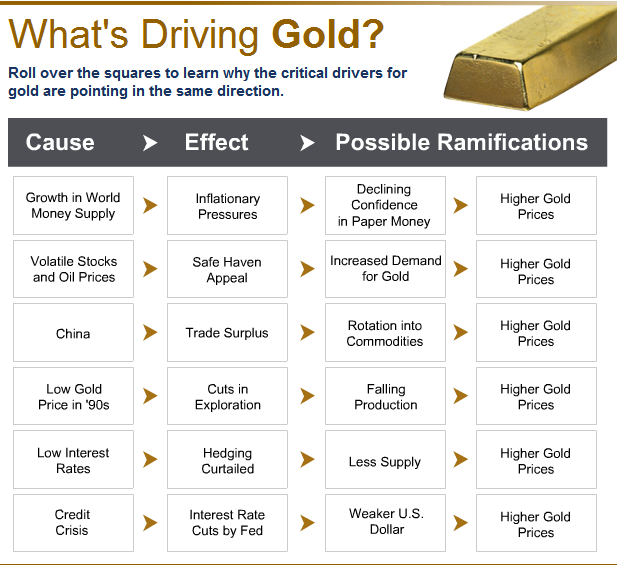
FAKTOR YANG MEMPENGARUHI HARGA EMAS DUNIA

https://blogger.googleusercontent.com/img/b/R29vZ2xl/AVvXsEjN6NwKmzQfKPtbccpMAguTHgyINNDDQwX_DkEOL_MB1EHReZ906RbYpEDoTh1uH-qePHXx6BKw3rQ3Ob02JaGRU6a8SVlclZv909XQK5mGVVX0vrmHCemm-TZ36AvAqoCC2Y5Ogtgz5Ujj/s1600/what+drivng+gold.png

SELAMAT MENYAMBUT TAHUN BARU 2011

SEMOGA TAHUN 2010 LEBIH BAIK DARI TAHUN 2009 DAN TAHUN 2011 LEBIH BAIK DARI TAHUN 2010. MULAKAN LANGKAH ANDA DENGAN SIKIT DEMI SEDIKIT. JANGAN BIAR MASA BERLALU TANPA ANDA MENAMBAH SESUATU SAMADA AMAL IBADAT, KEBAJIKAN DAN SEBAGAINYA. SEMOGA SEGALANYA BERTAMBAH BAIK TAHUN INI. INSYAALLAH.